W6m is a PITA to flash though.
1 Like
Apples vs oranges → apples vs skateboards.
“This is not true for semi-recent purpose built x86_64 (like alderlake-n, n100/ n97/ n150 or similar) devices (with typically two or four 2.5 GBit/s ethernet ports).”
Power consumption is way higher for x86 and especially for what you described.
Here is an ER-X flashed with openwrt @ 2.4w to 3.5w max for an apples to apples comparison:
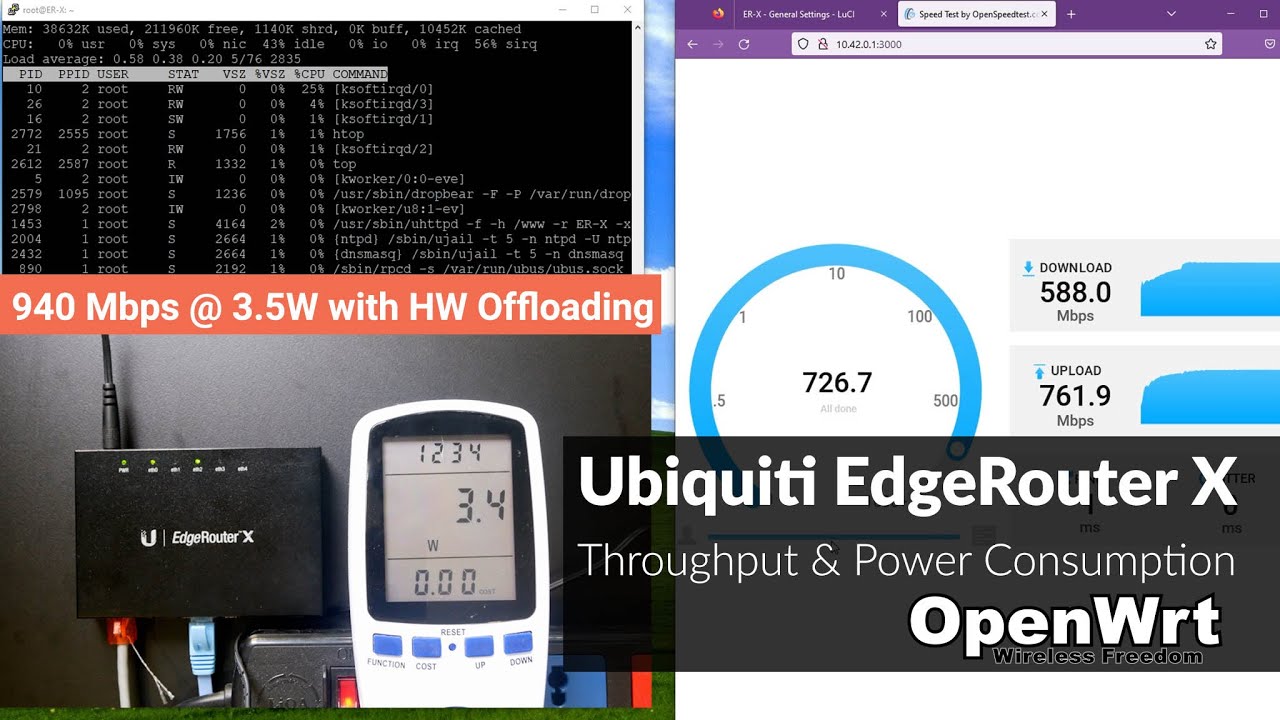
1 Like
That's impressive, but Ubiquity has tried to make running other systems harder, which means that it's not comparable to more open systems designed to run any operating system.
I would probably buy Ubiquity hardware if they were not actively working against my goals.
Also such tests would probably need to actually do some processing to be realistic. (You can't offload everything.) I didn't watch the videos.
Also, the security features on x86-64 seems to be better with e.g. TPM2.0 with encrypted root being practical to implement to get an enterprise grade system. Being able to deploy a system that has no issues with being stolen for example, is a very nice feature in some environments.
Offload - 2.5w; no offload - 3.5w
Any x86 devices hitting those number? Nope. Gets even worse with 2.5G. What I said was accurate in that x86 is going to use way more power.
I measured the power consumption with a USB-C PD power meter. It draws 3.5-3.7 Watts on average, broadcasting its Access Point to 2 devices (laptop and phone) being mostly idle. Running a speed test from my laptop over Wi-Fi (520Mbps down, 48Mbps up), it’s peaking at 7.4 Watts. Running the same speed test over Ethernet 100Base-T yields a power consumption of 3.8 Watts. 1000Base-T yields a power consumption of 4 Watts.
Don't need to buy ubiquity gear when openwrt one exists. Yet again, ARM uses way less power in an apples to apples comparison.
You ignored the TPM 2.0 part, but perhaps that was because I mentioned a particular brand without that feature as well.
I think having a “vanilla Linux” on a device interacting with the internet has some value as opposed to just an embedded Linux like OpenWrt, but it's impossible to and pointless to convince anyone of that.
Within the context of OpenWrt, if the OpenWrt One comes with optimal configuration for things like fast roaming when there are multiple devices, that's a good selling point compared to buying something it wasn't designed for.
In my last evaluation, I valued availability of the device as well and it being mountable to the ceiling as well as looking professional. The OpenWrt One didn't meet all those criteria.
You are inventing a lot of arguments I did not make.
Recommended router for long-term OpenWRT support
The OP doesn't want "vanilla Linux" recommendations.
I second suggestions already done:
- x86 based as primary router (with 2.5Gb ports, or better)
- Cudy WR3000H as separate AP (use 2.5Gb port as uplink)
I never suggested OP said those things. Please learn to read what's actually written.
Living in USA and need good AP don't look further.
Read OP's requirement on how it should be bought.